
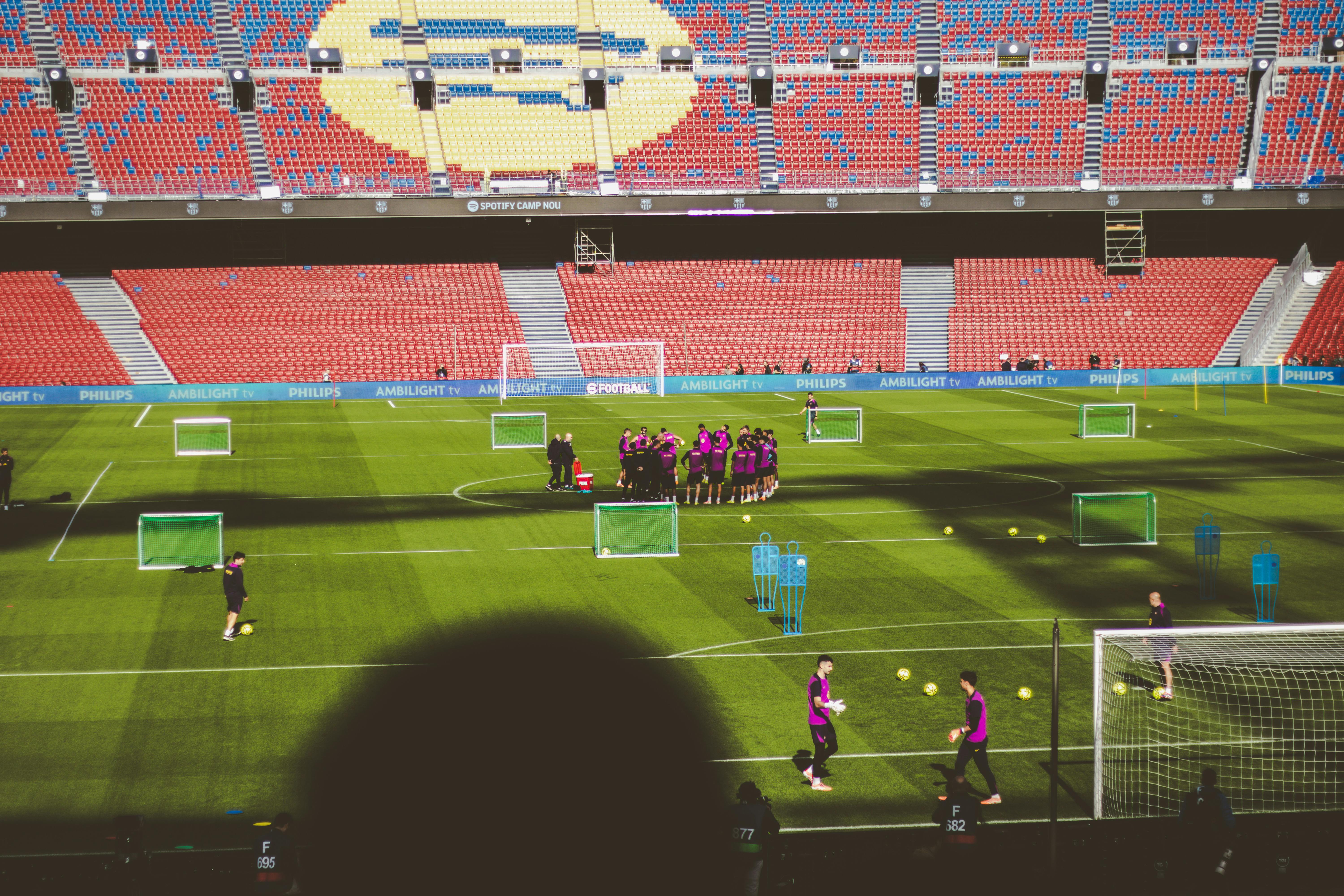
One of the most robust findings in football statistics is that playing at home is worth something. One of the most robust trends is that it's worth less than it used to be, and the decline has been remarkably consistent.
Home teams in top European leagues in the 1970s took a considerably larger share of points than they do now. The direction of travel is the same across countries, across divisions, and across decades. What's causing it is genuinely contested.
The natural experiment
The most informative evidence came from an unwelcome source. When matches were played without spectators at scale a few years ago, researchers had a rare opportunity to isolate the crowd's contribution.
The results were fairly clear. Home advantage shrank substantially in empty stadiums, and the largest single change was in refereeing decisions — the gap in cards awarded and fouls called between home and away teams narrowed markedly, in some leagues almost disappearing.
Interestingly, other components of home advantage were less affected. Home teams still had more of the ball and took more shots without a crowd, suggesting that part of the effect is about something other than the audience — familiarity with the surroundings, perhaps, or simply the psychological framing of being the home side.
So the crowd matters, mostly through officials, and there's a residual that isn't about crowds at all.
Candidate explanations for the decline
Travel got better. Away teams in the 1970s travelled by coach, stayed in worse accommodation, and arrived less prepared. Modern away trips involve charter flights, controlled nutrition, and hotels selected for sleep quality. That's a genuine reduction in the away disadvantage and it's probably a real contributor.
Pitches got better and more uniform. Home advantage used to include genuine familiarity with a surface that might be mud, might be frozen, might slope. Modern pitches are engineered to a consistent standard, so there's much less local knowledge to exploit.
Video technology reduced decision variance. If crowd influence on officials is the main mechanism, then any system that reviews decisions should reduce it. The evidence here is mixed and the timing doesn't fit perfectly, since the decline predates video review by decades.
Stadiums changed. All-seater grounds, better crowd control, further distance between spectators and the pitch in newer stadiums with running tracks or larger footprints. The intimidation factor of an away ground is genuinely lower than it was.
Professionalisation. Players are better prepared, better coached, and more accustomed to hostile environments through international and European football. A young player today has probably played in front of large away crowds many times before reaching a first team.
What doesn't explain it
A couple of proposals that don't hold up well.
Increased competitive balance. If leagues had become more balanced, you'd expect more draws generally, not a specific reduction in home advantage. And several leagues have become less balanced over the period, not more.
Tactical changes. There's an argument that modern tactical systems reduce the value of crowd energy, and I can't see a mechanism that would produce a four-decade linear trend.
The practical implication
For anyone assessing matches, the important point is that home advantage figures are era-dependent.
A rule of thumb derived from data twenty years old will overstate the effect today. And the effect varies by league — it remains larger in some competitions, particularly those with long travel distances, hostile atmospheres, or less consistent officiating standards.
It also varies by team. Some clubs have a demonstrably larger home effect than others, driven by genuine factors — pitch dimensions chosen to suit their style, an unusually intense atmosphere, altitude in some cases, or climate.
Treating home advantage as a single constant applied to every fixture is a simplification that costs accuracy.
The altitude case
Worth a specific mention because it's the largest and most physically grounded home advantage in world football.
Teams playing at significant altitude have a substantial and well-documented advantage over visitors from sea level. The mechanism is straightforward physiology — reduced oxygen availability affects aerobic performance, and acclimatisation takes weeks that a visiting team doesn't have.
This effect is much larger than ordinary home advantage and it hasn't declined, because it isn't caused by any of the factors that have improved. Better hotels don't help with hypoxia.
Where I'd expect it to go
My guess is that the decline continues but flattens, because the components that could be eliminated mostly have been.
What's left is the irreducible bit — genuine familiarity, the psychological effect of playing at home, and whatever residual crowd influence survives video review. That's a smaller number than it was and I don't think it goes to zero.
Which is probably good for the sport. A world where home advantage vanished entirely would remove one of the things that makes a season structurally interesting.